An Interview with Freya Cumming

cabbageswebbanner

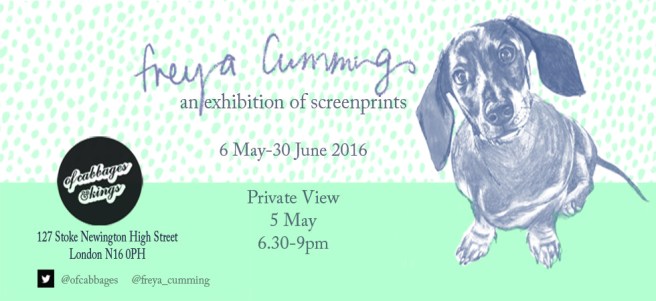
Spring is just about here. Or at least surely it must be close – we can almost smell it! Also, right around the corner is our brand new exhibition with one of Of Cabbages and Kings’ longest standing collaborators Freya Cumming. Freya will be traveling down from Dundee with her latest collection of screen prints fresh of the drying rack. The private view is on Thursday May 5th from 6:30 – 9pm. We hope you can make it along. In the meantime, we caught up with Freya and found out a little bit more about her art process and influences.

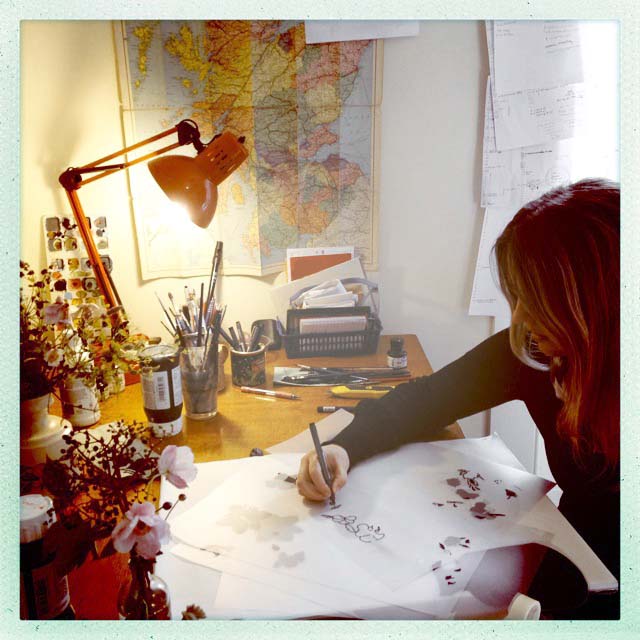
What is your artistic weapon of choice? Pencil, pen, paintbrush, printing squeegee…
I use them all, but if I had too choose one, my weapon of choice would be a propelling pencil. I love ’em! 
aboutpaage

Your art features many repetitive motifs (hot air balloons, Victorian figures, the ocean, etc.). Do you feel like you work with themes or that you are drawn to a particular image?
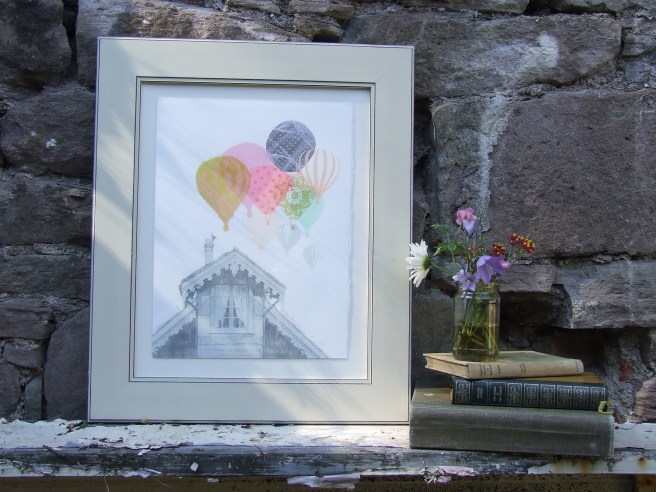
I don’t think that I have any particular themes other than that most of the work I enjoy making has some form of pattern, however small a detail it is, it’ll be in there! The balloon images became a theme by accident, I lived in Bristol for seven years and I thought one day I might try a balloon print, as they are such a familiar sight in the city. I enjoyed the endless possibilities of patterns and colours within the balloons and so I got quite carried away and produced a whole series of these. 
DSCF8910

Your images feature many built up layers. Can you tell us a bit more about that process? 
One of the pleasures of screen printing for me, is the ability to play around with the opacity of the inks when mixing them. Printing in overlapping layers, in varying opacity can come up with colours and effects that I aren’t planned, but that make printmaking more interesting for me. I like making it up as I go along! It makes what can be a very technical process, much more interesting and spontaneous.  

Can you tell us a bit more about founding Snap Studio, the artists co-operative in Bristol?
It all came about very serendipitously. My friend Frea and I were manning a pop-up shop in an old hairdressers in Bristol for a few days. We were chatting about how amazing it would be to have a studio, gallery and printmaking facilities under one roof. The man who had the keys to the hairdressers, just so happened to be the founding member of the ethical property company, and owner of  a beautiful 16th century building across the street. He offered it to us at a really reasonable rate which allowed us to seek help from the co-operative development agency in Bristol and go on to form a co-op with six other printmaking friends. We are all either just graduated/ or graduating, so it was perfect timing. It was the perfect setting- post-uni to have somewhere to work. 

SAMSUNG CAMERA PICTURES

You recently moved back to your hometown in rural Scotland. Has this move changed or influenced your work? 
I’ve realised with hindsight that it did at the time. I’ve always been inspired by my surroundings so suddenly, instead of urban scenes, I was drawing chickens and squirrels. I found I missed the urban landscape and I realised there was a danger that my work was unintentionally becoming overly countrified, so I moved my studio from the village to nearby Dundee.

How long have you been printing?
I learned to screen print the same year I graduated in 2001 – so on and off, around fifteen years of squeegeeing ! 

IMG_1435

What is your favourite takeaway?
All of them?!. I live in the middle of nowhere though so takeaway is rare! No-one will deliver this far either 😦

Follow my blog with Bloglovin

Q&A with Tiff Howick

Tiff-Howick-facebook-banner-updated

We are excited to announce our next exhibition will be with Tiff Howick. It will run from Thursday February 4th, with an opening preview on Wednesday February 3rd from 6:30-9pm.

Tiff’s artwork features striking portraits of animals, focusing on dogs and British wildlife. They are done with a loose, expressive style in black ink, printed over a strong colour on crisp white paper.

Tiff-Howick-photo-1

What is your artistic weapon of choice? Pencil, pen, paintbrush, printing squeegee…
It is very hard to choose, I would say overall it’s a paintbrush, I really enjoy experimenting with brushmarks to create different textures.  

Your art features striking portraits of animals. Have you always been drawn to animals?
I have, I grew up with pets – Jack Russells, rabbits and guinea pigs. I also spent my summer holidays in Norway where there were sheep grazing in the forests and we’d see squirrels, deer and elk.  

Your animals are very expressive, like they each have their own personality. Is that something that evolves as each animal is drawn?
Mostly the expression is intentional, I’ll have a reference image with an animal in a pose that I think represents a particular behaviour or emotion such as the spirited French Bulldog or the thoughtful Greyhound.  Sometimes the expressions evolve and either reflect the mood I’m in when I’m drawing or I make subtle changes to the eyes to create an overall feeling that works for the drawing. 

Reading the expressions in my screen prints is subjective, people commenting on my work have seen a variety of different emotions. 

Your art is inspired by your Scandinavian heritage, vintage children’s illustrations, and contemporary fashion illustration. On the surface these styles are quite different, what is it within them that you think draws them all together so successfully?
Over time I have incorporated in to my work the elements of each style that I most admire.  Limited colour palettes from Scandinavian design and the creation of striking images with just one or two colours.  The bold colours are from Scandinavia and my childhood picture books, two of my all-time favourite illustrators are Carl Larsson and Richard Scarry.  The loose, textured brush marks and sketchy lines are inspired by fashion illustration, I am a huge fan of David Downton’s work. 

Tiff-Howick-yellow-hare-screenprint-500x700mm-interior-design
One of your most popular prints has been the Yellow Hare, which features a bright splash of yellow. Some of your prints feature colours that are not traditionally associated with the animal depicted. Do you feel that the colour can change the mood of the animal?
I’ve used bright primary colours to represent extreme versions of the animal’s natural colour, using one vibrant colour to simplify the final image. This sometimes ties in with the mood of the piece, the bright red fox staring assertively over it’s shoulder.  The hare is resting but alert, the bright yellow also representing a hot day in a cornfield.  

Tiff-Howick-red-fox-I-screenprint

How long have you been printing?
I first printed a long time ago on an art foundation course.  I rediscovered screenprinting fairly recently and have been using it to create most of my work for just over three years. Tiff-Howick-screenprinting-work-images

What is your favourite takeaway?
Since starting to work for myself I’ve researched and read a lot about how to make it work.  I would say the best advice, and the hardest for me to stick to, is to focus. Being creative my head is always full of new ideas, there are so many things I want to do and experiment with.  To make a living out of work that I really enjoy I’ve had to pick one idea and work really hard to make my screenprints as good as they can be. 

Or if you mean food it would have to be Indian :o) 

Follow my blog with Bloglovin

Ashley Amery Inverview and Exhibition

We are excited to announce the next exhibition in the shop. Ashley Amery will be displaying new prints and drawings on July 2 from 7-9pm. If you are interested in attending you can RSVP with our Facebook event.

We were able to grab Ashley for a little interview about her work and inspirations, as well as a preview of some of her pieces that will be displayed in the show.
Web Banner OCK show_2What is your artistic weapon of choice? Pencil, pen, paintbrush, printing squeegee…
A pigment liner pen, or a small paint brush.

You have studied art in California, Italy and in London. Did you find that there were different approaches to art in each place? Has that influenced your work?
I think place always influences work, the landscape as much as the people. In California, I studied under artists influenced by Abstract Expressionism, who focused on the act of painting as an expression of the unconscious. California felt big and open. Large canvases layered with paint made sense in the space there. When I moved to Italy, it was a different world, packed with detail, and an extensive past. I had access to darkrooms and printmaking studios, and a library full of art theory books. I became interested in photography and how an art piece can embody a concept. I wanted to live in London partly because I read about ideas coming from the art colleges there. I loved the work of artists who used their practice as a way of thinking philosophically, often humorously. During my MA at Camberwell I began to draw about my internal struggles to define my identity. Since then I have circled back to the unconscious, approaching it with illustrative imagery rather than painterly gestures. Using the narrative aesthetic of illustration can be an unsettling way to point toward questions about limitations. Opposition within a piece creates energy.Ashley Studio shot

Your pieces evoke storytelling, imagination and play, while also hinting at darker mysteries. Can you tell us a bit more about your inspiration for creating these pieces?
For me, art is play that helps me access my thoughts. I like to think of my drawings as a way of looking for the unknown self.

Amery_swimming pool
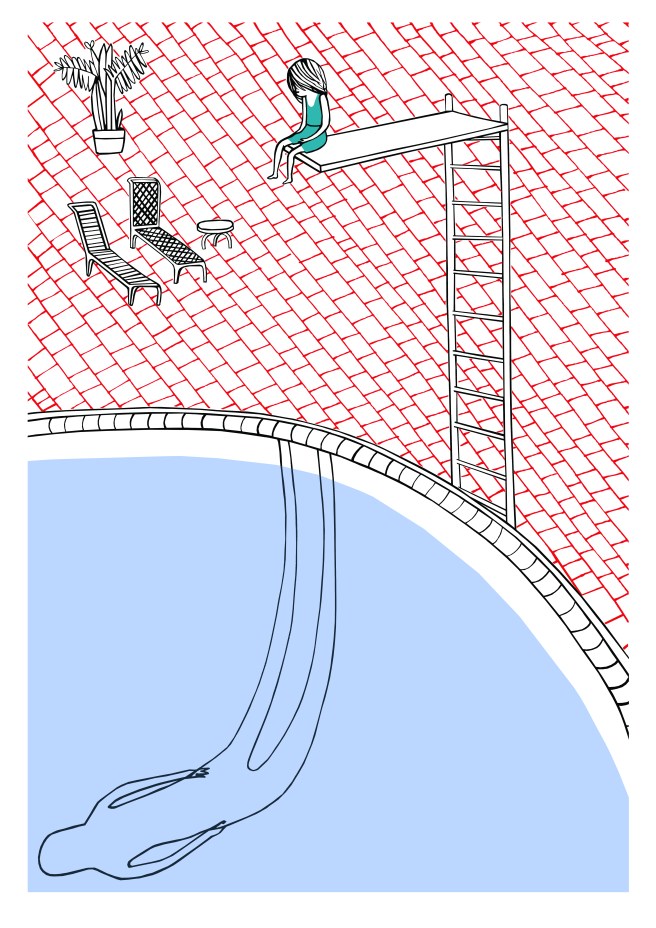
Swimming by Ashley Amery 420×594 mm.

You also run a business (White Wall Yellow Door) creating children’s resources for museums and galleries. Do you find it very different to create art for children than adults?
The work I do with WWYD is about creating space for children to use their imaginations, which often means having to think about bigger ideas and take away much of my own detail work. I co-direct with an artist friend of mine, Sophy Rickett, and we enjoy the challenge of getting ideas about art across to young people. Each project has a direct aim and a client, providing a nice structure to work within. It’s exciting to make something kids spend time with, giving them ways to discover their own ideas and abilities.

AshleyPrints_01 rp
Story no. 1 by Ashley Amery. Gouache on paper.

Do you find yourself returning to themes with your work?
I am fascinated by the idea of the human mind, memory, and the unconscious, especially Jung’s archetypal Shadow. I have returned to this in a number of drawings and prints.
How long have you been printing?
I have been printmaking in some form since 2005, and I’ve always been drawing.

What is your favourite takeaway?
Bos Cirrik

Marcelina Amelia Exhibition and Interview

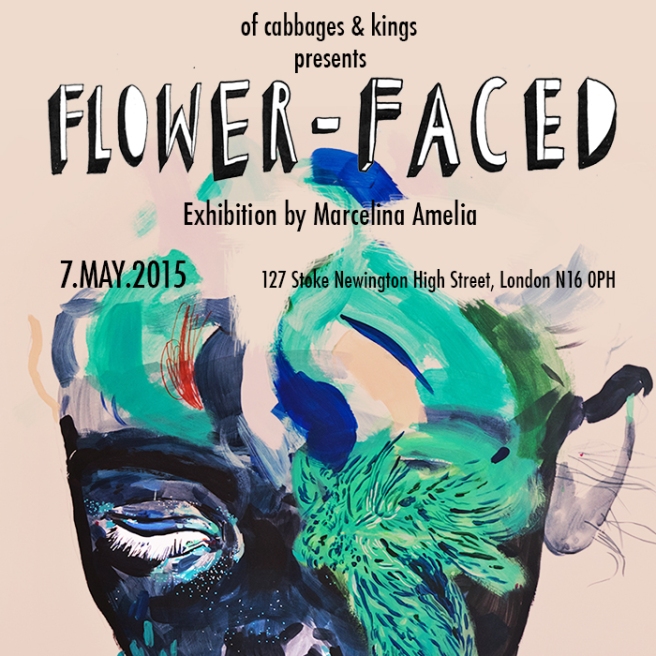
Our next exhibition in the shop is with Marcelina Amelia on May 7, from 7-9pm and will continue through to the end of June. We will be showcasing Marcelina’s limited edition hand-pulled screen prints and original paintings.instagram_ofcabbages

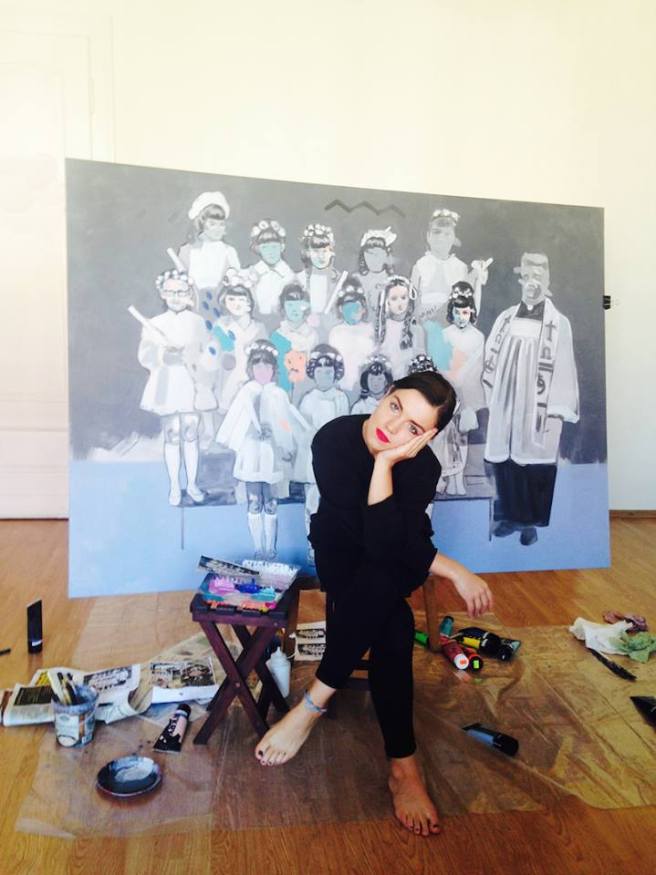
Marcelina’s work combines painting, drawing and screen-printing techniques. Originally from Poland, she draws inspiration from Polish religious iconography, folk tales, childhood memories, dreams, sexuality and human relationships. Her works are an uneasy mixture of lustful darkness and adolescent innocence. Inspired by pot plants, trapped wildernesses in miniature, the overcrowded streets of London and never ending online content, this body of work examines the relationship between humans, individuals and their environment. Marcelina utilises nature as a metaphor for everyday feelings and headaches.

-What is your artistic weapon of choice? Pencil, pen, paintbrush, printing squeegee…
I actually use all of them. I always start with the pen or pencil though, and then see where the work takes me. Because of my Fine Art and Illustration background, screen printing came in handy as I can mix both painting and drawing in one.

-What do you miss the most from living in Poland? 

I miss polish food, especially my grandma’s cooking. I also miss polish humour, it is very hard to translate it into another language. Believe me I’ve tried! I also miss the nature, in Poland we have both mountains and the sea, and beautiful countryside too –
and people, obviously.

Marcelina_cabbages_kings-How do Poland and London influence your work? 
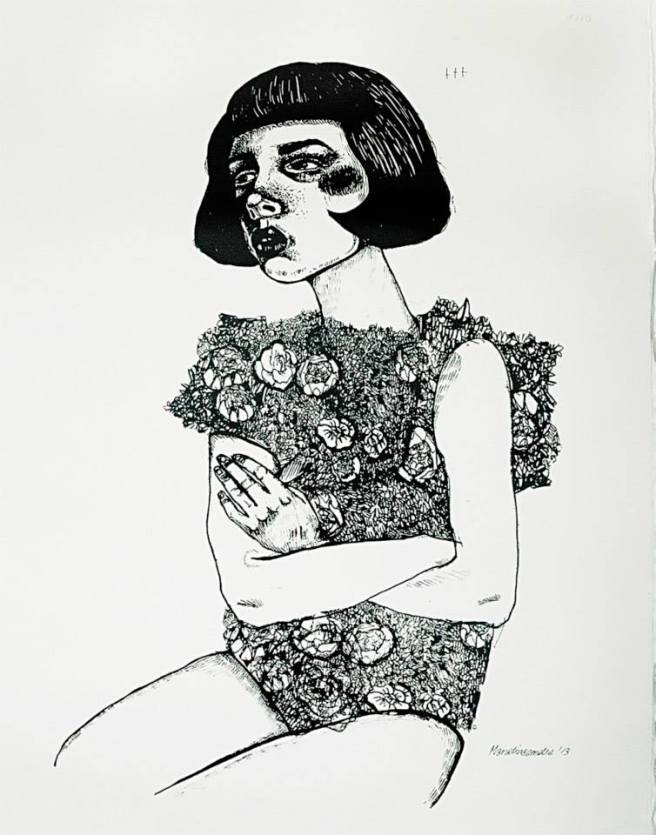
Marlene Dumas once said that she never quite knows where she is. I have a similar feeling, that I’m always somehow divided between London and Poland, and that I’m never 100% present in a space and time. Suffering from a typical immigrant expat syndrome made me more aware of my own culture, and it became a source of the inspiration for my work.

Polish folk tales, religious iconography the aesthetics of School of Polish Poster, my own memories of growing up in Poland and the importance of family values have had a strong impact on my work. But, at the same time, London taught me a lot about the freedom of expression and being experimental, which gave me all those feelings that I would never experience if I stayed in a country that I was born in.

London is full of extremely talented people and interesting events, which motivates me. I also think that it made me grow up faster and made my skin thicker. But most importantly London, and its overcrowded alienation, is one of the themes that I find myself attracted to.Marcelina_cabbages_kings_girl

-A lot of your work seems to be very self-referential. Do you see it as a self-portrait?

Sometimes it happens unconsciously, I’m not trying to draw myself, but the final outcome resembles me. When I was a kid and I was learning to draw, sometimes because of the lack of the model around, I would sit in front of a mirror and spent hours drawing myself in different poses and expression just to practice. I would spent a lot of time drawing my younger cousins too, so every time I paint or draw a kid it has something that resembles one of them.

Usually I’m trying to tell a story or to illustrate a certain feeling, and a person that appears on a paper is just like an actor that is helping me to communicate the message.

At the same time, I can’t deny that my work is very personal.

-Do you find yourself returning to themes with your work?

Yes, I do often revisit the themes of my own and my family’s past, of growing up. I constantly find my family photographs as a great source of inspiration. Our relationship with the environment, where are we in terms of time and space, is also one of the themes I find myself going back to. I do often try to illustrate emotions.

– How long have you been printing?  

I’ve started learning about screen printing at the end of 2013. I took a fantastic course at Print Club London, and haven’t stopped printing since then.

-What is your favourite takeaway?

I’m trying to eat healthy these days, but I would not ignore a good kebab from Super Kebab in Stoke-Newington and I love sushi from Wasabi.
I do usually go out for coffee though, they have an amazing flat white in Haberdashery, and fantastic cakes in Bienvenue!

Introducing Marc Gooderham

A new exhibition went up in the shop over the weekend and I’m very excited to let you know all about it. There’s an element of the outside coming in here as there’s a few immediately recognisable local street scenes from the surrounding East End.

Marc has put together a series of Limited Edition Prints concentrating on the city’s decaying and unique architecture. They capture the singular beauty to be found in those neglected buildings that have fallen into disrepair as the living city of London continues to evolve around them.

“I had always set out to paint the city I knew and which is close to my heart. Avoiding the repetitiveness of London’s landmarks depicted in many paintings my aim was to capture an alternative view of the city. As much as I love the monumental buildings that create our skyline, it was the side streets and alleyways that seemed to hold a mystery for me.

I love the freedom of the city, getting lost in the crowds. It can be claustrophobic yet there’s also the feeling of loneliness and isolation. It’s these feelings that allow you to create your own world within the city.The atmosphere can change according to weather, season and the time of day, which makes it the perfect subject to paint. It can be the drama of sunlight hitting a window or the glow of a street lamp or chimney tops against an unsettling sky.

I began to explore the East London streets discovering something magical and new each time. I saw the street corners in a different light, almost appearing as cinematic compositions. I was able to visualise them from reality to canvas.”

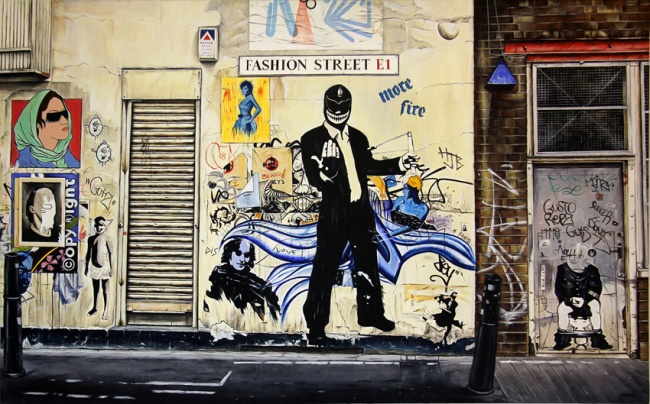
Fashion Street
Fashion Street by Marc Gooderham

As the face of London changes overnight, it’s apparent that these views of the city, the architecture of crumbling and faded grandeur are beginning to vanish before our eyes. Desolate buildings, with their peeling paint, numberless front doors, and glimpses into empty rooms through uncurtained windows invite contemplation – of the lives once lived here, and the new lives that continue to do so.

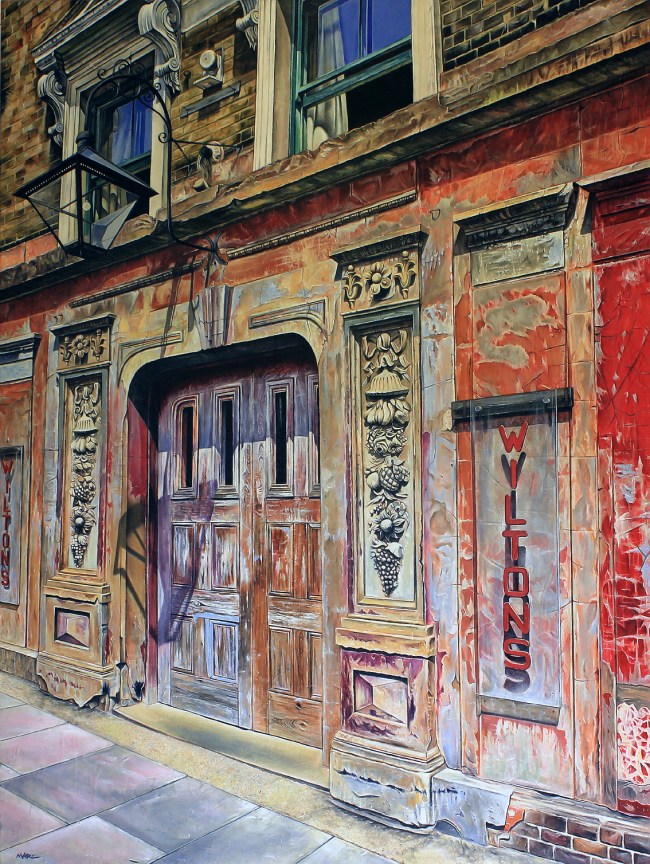
Wilton's Music Hall
The Music Maker by Marc Gooderham

The Music Maker illustrates the facade of the famous Wilton’s Music Hall, an example of London’s decaying and unique architecture, beautiful and decorative buildings that appear desolate, living on amidst an ever-evolving city. The layers of paint applied to Wilton’s exterior over the years chime with the generations of Londoners ushered through her doors to enjoy music, variety and spectacle. Even if you’ve ever passed the building you can imagine the revelry and cabaret emanating from within. Though paint may fade, Wilton’s Music Hall remains one of the most colourful places in the East End.

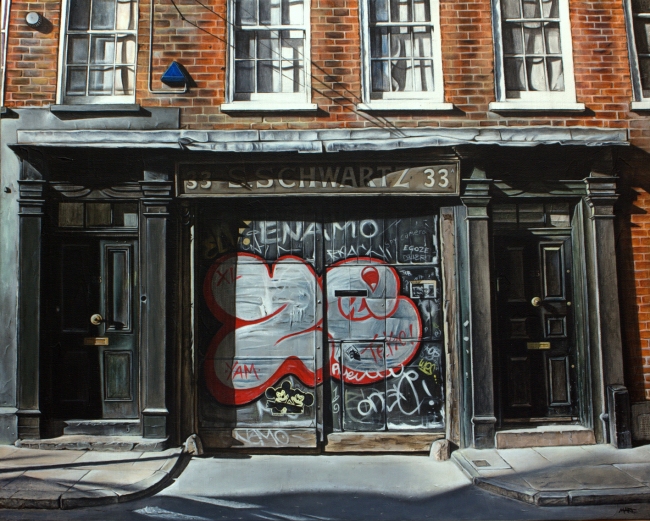
Late Afternoon, Spitalfields
Late Afternoon, Spitalfields by Marc Gooderham

Marc’s prints are currently on display at Of Cabbages & Kings