
By George Cullen.
I’m starting a series of blog posts about the materials of printing. In these I will examine with more detail, the materials and methods behind the prints at Of Cabbages and Kings. First up in the series I am going to look at paper size and how it came to be that so many artists work with the same paper measurements – in particular the ‘A’ size.
You’re probably already aware that a lot of the paper our artists use and the paper you use at home or at work is an ‘A’ size. As a result so are a lot of the frames that we stock, especially the more popular ones. So what is ‘A’ size paper?
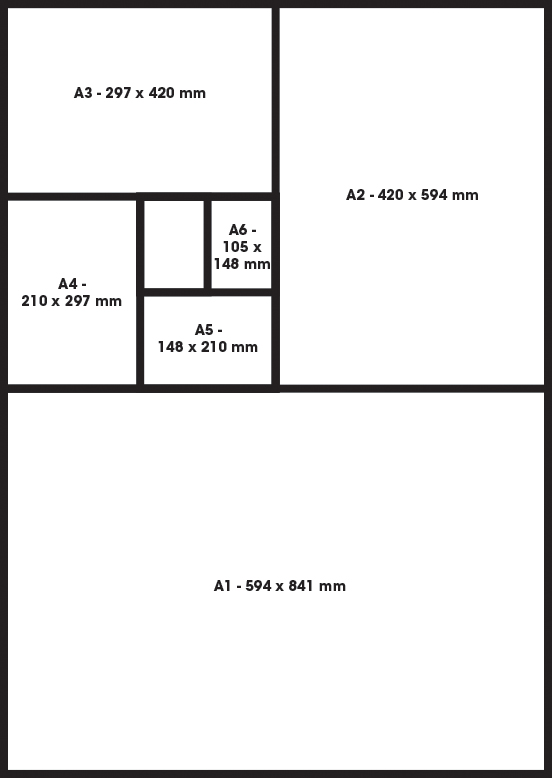
A diagram showing how A sizes fit in relation to each other.
‘A’ sizes form a group of papers whose dimensions are exactly half of the larger one before it, while also maintaining the same proportions. For example an A3 sheet is made up of two A4 sheets and two A5 sheets can me made from one A4. A0 being the largest sheet in the series at 841 x 1189mm.
The ‘A’ size paper measurements began their life in Germany in the 1920s. The standardisation was introduced by the ‘Deutsches Institut für Normung’ German Institute for Standardisation aka DIN who were responsible for the standardisation of many elements of German society including industrial output and technology. They have a wide range, for example DIN 72552 is responsible for electric terminal numbers in automobiles where as the one for paper size is DIN 476. There is even a typeface DIN 1451 which was designed in 1931 for its legibility.
The ‘A’ sizes and their metric measurements were adopted by Britain in the 50’s as part of the metrication of measurements and replaced ‘Foolscap’ which was 8½ × 13½ inches. DIN 476 allowed paper sizes to be standardised across Europe and many parts of the world. By 1975 so many countries were using DIN 476 it was established as ISO 216, which is the ‘International Organisation for Standardisation’ and ISO 216 is the official United Nations document format used today. ISO216 is used in every country in the world, apart from the United States and Canada whose paper ‘US Letter’ and ‘P1, P2’ etc is still based on an imperial measuring system.
The largest A0 sheet has an area of one square meter, which was the result of Germany adopting the metric system for their measurements. This also aided in measuring the weight. As paper weight is worked out as grams per square meter (gsm). So the weight of a sheet of paper is how many grams are per a square meter of that paper. The heavier the paper, the higher the gsm and generally the better quality!

An A4 sheet showing folds of A6 and A5
So why isn’t A0 a simple meter square? Well this reveals the simple elegance of the ‘A’ measurements. If you fold a square in half you get two rectangles that bear no resemblance to the original proportions. The A sizes allow you to fold the paper in half and get the same proportioned piece of paper as a result. This is great when you have to resize artwork to fit different sheets of paper, perfectly demonstrated in the giclée prints of Mister Peebles. The ‘A’ size is used to give you the choice of having a larger or smaller print, without compromising the original artwork.

Mister Peebles – Scale Great Heights in A2, A3 and A6 sizes
So next time you are in Of Cabbages and Kings and looking at prints, take some time to consider the paper sizes. If you can’t spot the A sizes straight away look at the back, where we have written the dimensions. You might want to think about how you hang them on the wall at home. You could have one large A1 print or instead four A3 ones in the same space. That is the joy of the ‘A’ system as the structure is already set down in the large A0 and the other sizes are worked out by halving the space.


 ofcabbagesandkings